
Cooperation for climate resilience in Moravská Nová Ves
Published: Dec 2, 2025 Reading time: 4 minutes Share: Share an articleOn the first Monday afternoon of November, the newly restored attic meeting room of the Moravská Nová Ves municipal office—rebuilt after the devastating tornado—hosted a discussion on a wide range of measures to increase the area’s resilience to the impacts of climate change. Participants discussed difficulties the municipality faces when putting such measures into practice, as well as strengthening the mental well-being of residents.
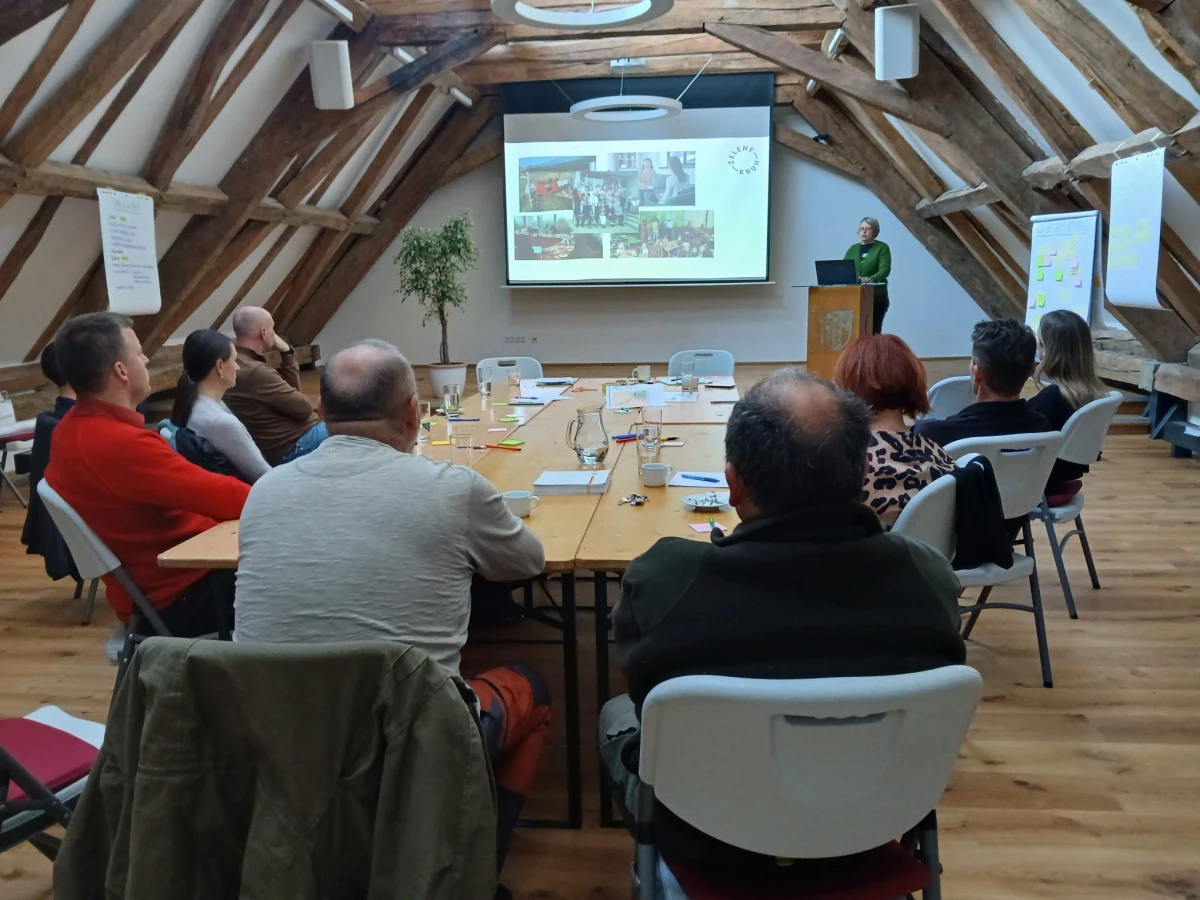
The Hodonín-based People in Need Climate Community Support Centre held this meeting together along with Zelený kruh and Socionaut and the municipal leadership. It was convened as part of ongoing cooperation on the development of mitigation and adaptation approaches in the area affected by the tornado.
The discussions included members of the municipal leadership and the opposition, a representative of the local hunting association, a local orchard grower, the agronomist of the agricultural cooperative, a representative of municipal technical services, and an environmentally-minded forester. As Roman Klecker, Programme Manager for Increasing Resilience to Climate Extremes at People in Need, noted: “It is not always easy to bring so many active local people to the table, but in Moravská Nová Ves, after the experience with the tornado, it has been remarkably successful.”
The discussion began with what climate change means to each participant, how they perceive its local manifestations, and how to respond to them. Almost everyone mentioned long-term drought, the loss of biodiversity, overheating in and around the municipality, and strong winds. These winds dry out and carry away the most valuable layer of soil. When heavy rains follow soil which has been compacted by heavy machinery cannot absorb the rainfall. Farmers and foresters described how mild winters mean that more harmful insects survive, such as aphids, ticks, and other pests, while others pointed to uneven rainfall distribution throughout the year. One message, however, came from all: the urgent need to significantly increase the amount of greenery both inside the municipality (in the built-up area) and outside it (in the surrounding landscape).

The Climate Action Plan as a starting point for change
The discussion revealed that participants held different opinions on various topics. Yet they were in complete agreement that the Climate Action Plan developed within the EUKI ELCA project is essential for the municipality. As Deputy Mayor Jiří Fila noted, the document covers the entire municipal territory, and after a year of data collection, thorough field surveys, and input from local stakeholders, it proposes a range of technical and nature-based solutions with both mitigation and adaptation potential—measures that can improve the local microclimate and thus the quality of life in the municipality.

Participants also agreed on the importance of discussing climate topics with all residents and highlighting, for example, that even a front garden filled with concrete, gravel, or river pebbles worsens the local microclimate, prevents water from soaking into the ground, and contributes to overheating public spaces.
According to Mayor Zuzana Jandáková, much-needed tree planting is often complicated by protective zones around utility infrastructure. The municipality is therefore trying to plant wherever possible and to use retention tanks to collect as much rainwater as possible for irrigation. The municipal leadership also places hopes in the upcoming comprehensive land consolidation process, which is slowly unfurling.
The tornado and its socio-psychological effects
“A widely discussed topic was the direct experience of the tornado and the reactions to it—the different ways people experienced community cohesion, or the ongoing need for psychosocial support. Many also observe changes in behaviour in the municipality, among each other, and within themselves. This is an equally important topic that we must address,” added Roman Klecker.
The roundtable showed how citizens’ attitudes towards rebuilding the municipality have changed over the four-and-a-half years since the tornado. It helped all participants define their next priorities and identify where to find support and professional guidance.
EUKI ELCA Community Climate Action Support Centres
These centres were established in the spring of 2024 in Hodonín and Timişoara as a space for meetings of the local active public, representatives of municipalities, experts and various initiatives with the aim of supporting and developing local climate protection projects. They are intended to help disseminate and share information and experience and also function as a platform for the future establishment of a regional Climate Council. From the beginning, the Hodonín office of People in Need has been engaged in direct assistance to municipalities in the South Moravian region of Podluží affected by drought, flash floods and tornadoes. Today, as a climate community centre, EUKI ELCA offers municipalities, among other things, the creation of climate action plans.
More here: https://www.euki-elca.net/activities/community-support-centre


